

You’ve read all the books about self-compassion.
You’ve listened to the podcasts.
You’ve talked about it in therapy for years.
So why is it still so hard to be kind to yourself?
You are not the problem. And it isn’t that you don’t know enough ~ the problem is that understanding self-compassion is very different from actually living it.
Instead of giving you more to think about, Everyday Self-Compassion shows you what to do: simple art journaling* that gets you out of your head. So you can treat yourself the way you'd treat a friend.
*No art skills needed.
8-week live online program
Join the Priority List
Think back to when you were about
nine years old.
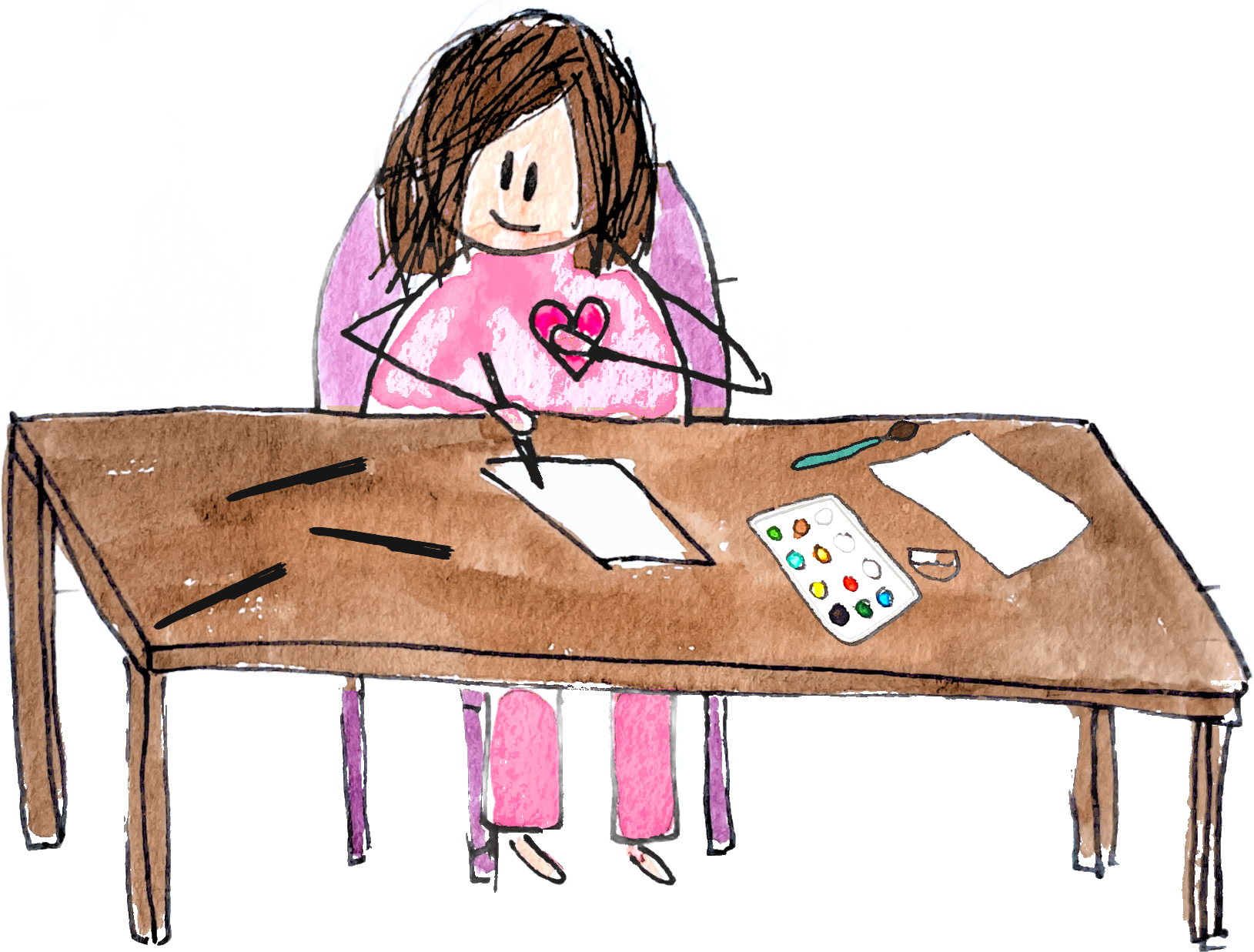
Remember that girl? Art supplies spread across the floor or the kitchen table, drawing anything and everything. There was a time when she wasn’t worried about whether it was “good” and when she wasn’t comparing herself to anyone. She didn't question whether she was enough. And her inner world was vivid, alive and completely hers.
And then, somewhere around that age, she stopped.
Maybe someone laughed at a drawing, or a teacher gave her a grade that said “needs improvement.” At some point she learned ~ the way many of us learn ~ that she's not enough. Instead she needs approval from the outside, and it feels safer to look out there than to trust her own creativity.
So she put down her pencils. And decades later, here you are ~ a smart, capable and inherently creative person who understands self-compassion and maybe has even had breakthroughs about it in therapy. You’ve screenshot the inspiring quotes. You know all the right words.
And yet that harsh voice in your head is still running the show.
Here’s something you may not realize: that girl with her art supplies spread across the table didn’t go anywhere. Her imagination is still in there ~ it’s just been hijacked.
Have you ever noticed how creative your inner critic is?
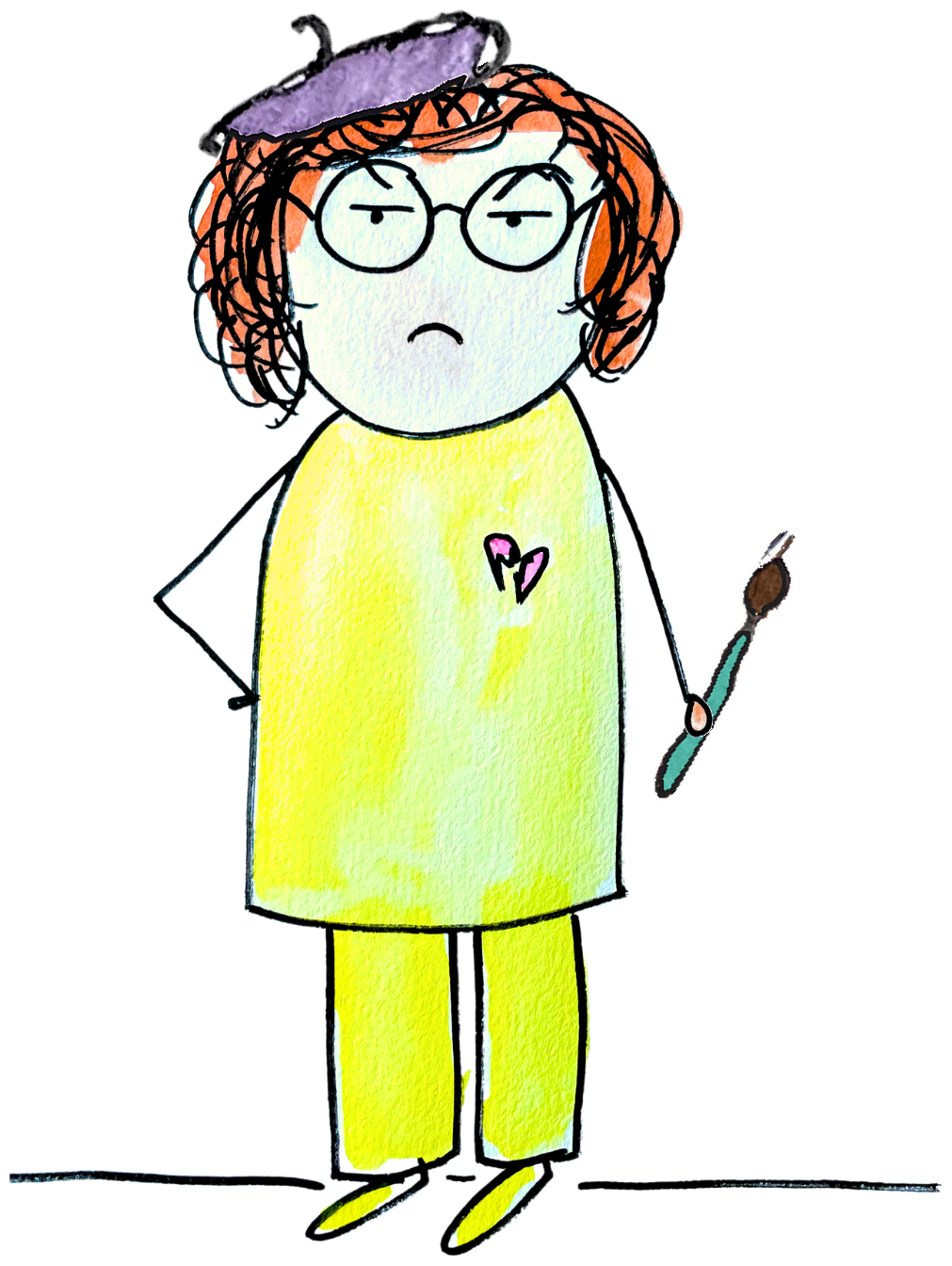
So devoted to its craft of re-living that awkward conversation from last week, imagining all the worst-case scenarios before a big event, and picturing every way you’re falling short. While its stories can be extremely convincing, your inner critic doesn’t live in reality. It lives in a world of twisted illusion. You’ve been trying to reason with it, and live up to its impossible expectations, standards and demands, but…
You can’t think your way out of self-judgment.
That critical voice has been telling horror stories since you were young ~ since around the time that girl put down her pencils. It’s got well-worn habits and distorted beliefs that formed long before you had the ability to question them. So gathering more information and thinking about the idea of self-kindness will keep you stuck in your head, and exhausted from an argument with a part of you that doesn’t operate on logic.
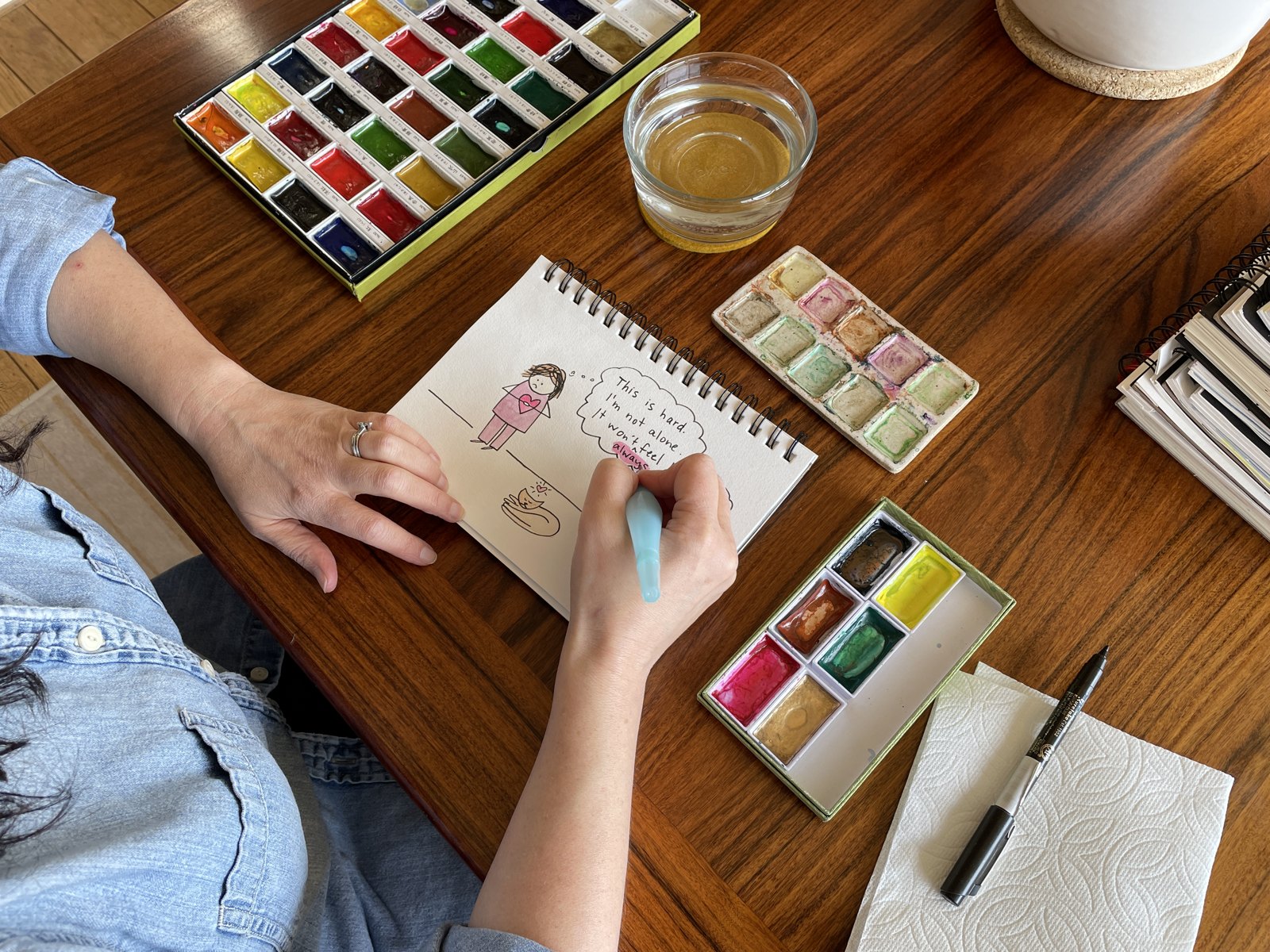
Your inner critic hijacked your creativity ~ and you can take it back.
This is the key to real-life self-compassion.
Books, affirmations, podcasts, therapy insights ~ they all tend to live in the realm of words and thinking. But the horror story of “I’m not enough” was written with imagination ~ so words and thoughts won’t change how it ends. The story has to be met on a different level ~ through experience, through the body, through deciding to create something new with your own two hands.
Art journaling works when nothing else has, because when you draw and paint, you give that young, creative part of you a missing and necessary experience. You take her seriously again ~ you free her up for self-expression. And you show up with kindness, on the page. Change doesn’t happen through insight and understanding alone; we need to apply what we know through practice. And in your art journal, page by page, self-compassion becomes something you can see and feel ~ and then it becomes how you show up in real life.

Meet your guide
Hi, I’m Lea
I’m Lea Seigen Shinraku. I’m a licensed therapist and have been leading self-compassion groups, workshops, and trainings for more than 18 years. I’ve also been a Zen practitioner for over 25 years.
And I know what it’s like to struggle with an intense inner critic. Most of us never learned how to be kind to ourselves, and the habit of self-judgment runs deep. Just because you understand what self-compassion is doesn't mean you know how to be kind to yourself in real life.
Through my own practice and my work with students and clients, I’ve seen what helps close that gap: putting paper, pen and paint back in our hands. When self-compassion becomes something we practice on the page, it becomes what we do in everyday life.
But maybe you’re thinking…
I’m not artistic at all. I can barely draw a stick figure.
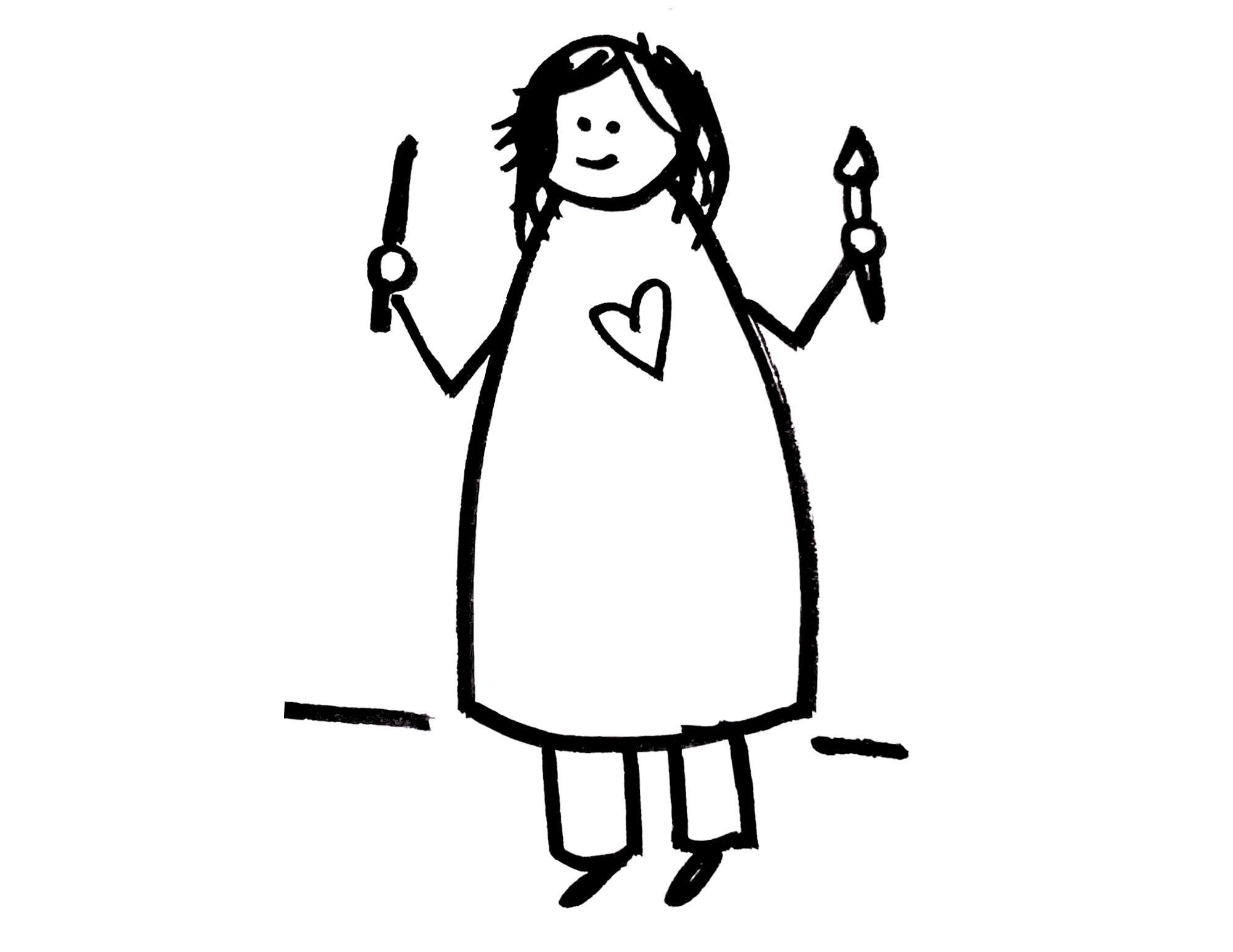
If you can write the letters of the alphabet, you can do this. It’s not art class, and no one is grading you ~ the last time someone did was probably when your critic moved in. In art journaling, there’s no “good” or “bad.” A weird-looking drawing can say more than one that’s all about technique.
I understand self-compassion. I don’t need art journaling to tell me to be kind to myself.
I believe you get it ~ intellectually. But if that were enough, you wouldn’t be here, reading this. Self-kindness has to live in your hands, your nervous system, and your Tuesday afternoon, when you spill coffee on your laptop and your inner critic yells at you.

This feels silly. I’m an adult.
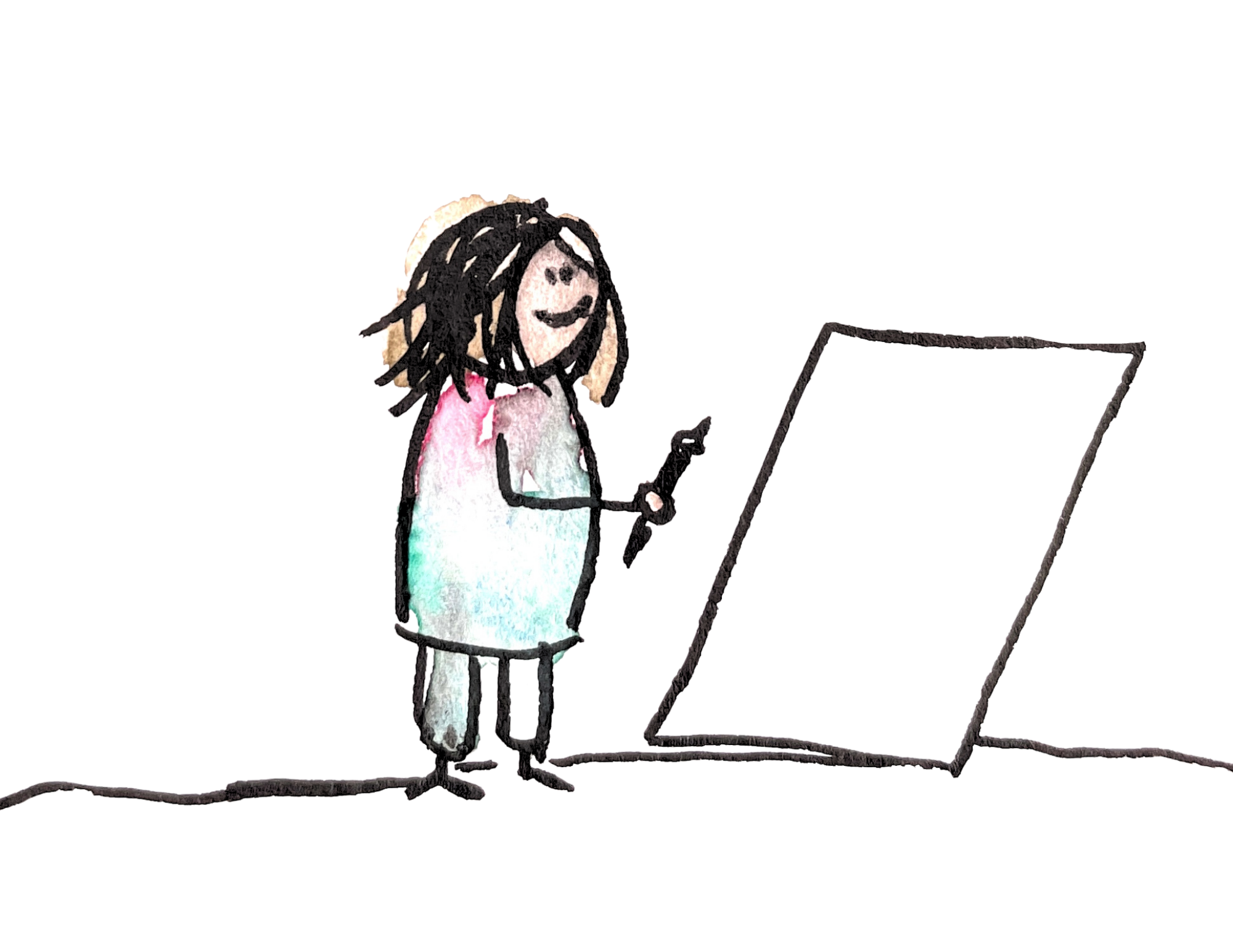
The girl who put down her pencils at nine doesn’t think so. She’s been waiting for you. That’s why many adult students tear up in their first art journaling session ~ a part of them they’d forgotten about finally gets to come back.
If you’ve read this far, something in you already knows:
You don’t need more information.
You need to do something different.
Self-kindness is more than a nice idea. I created this program to bring it into your real life, so it becomes what you do, day to day.
Curious what that looks like?
See what’s inside ↓Introducing…
Everyday Self-Compassion
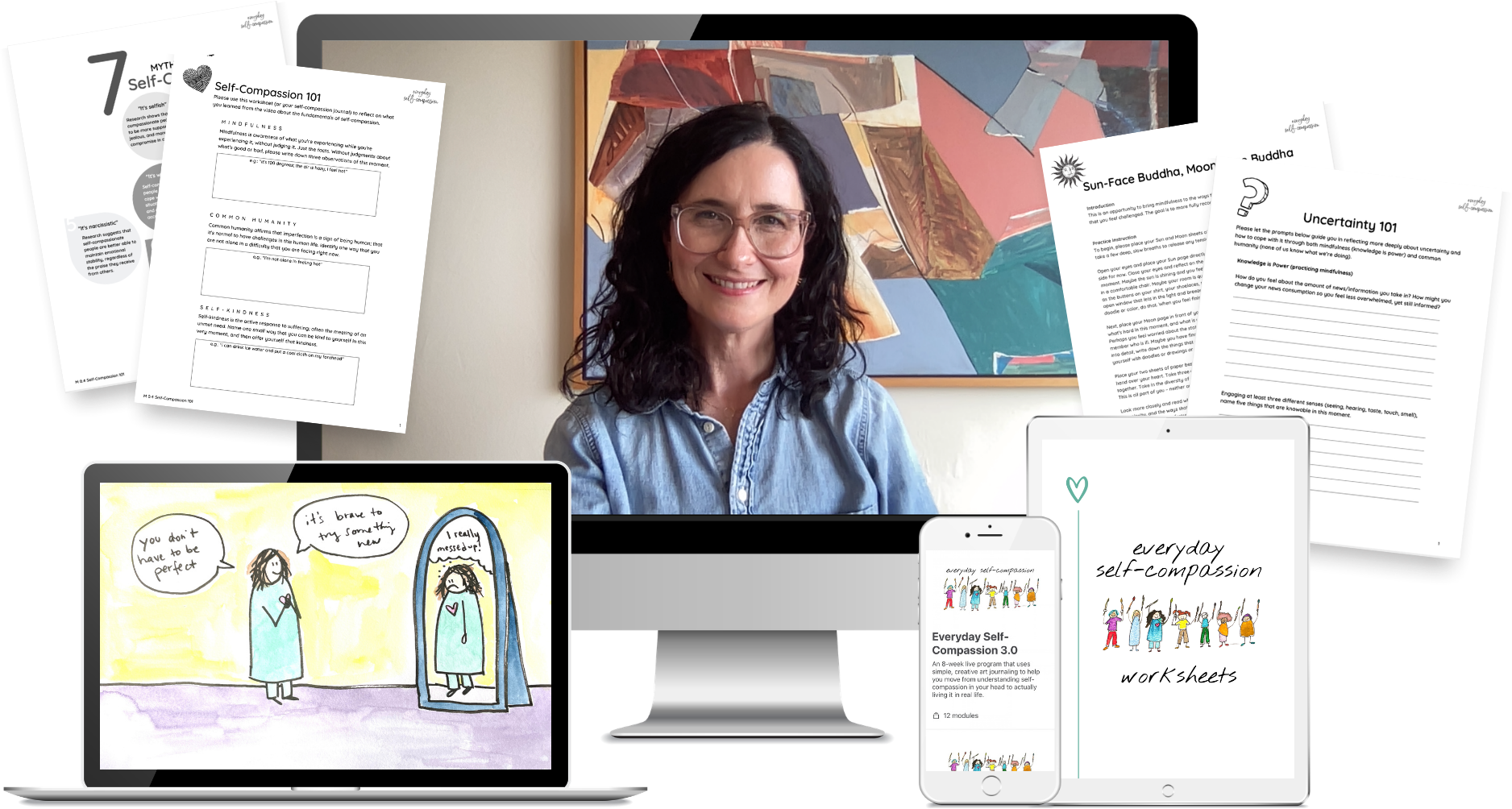
The 8-week live art journaling program that turns self-compassion from a good idea into a lived experience
Everyday Self-Compassion is an 8-week live, online group program that helps you be kind to yourself in real life ~ through live classes, guided art journaling practices, video lessons, printable worksheets, and a half-day immersive retreat.
8 Core Learning Modules + Matching Worksheets that take self-compassion off the bookshelf and into your real life ~ so when your inner critic pipes up, you know exactly how to answer it ~ and meet yourself with kindness instead of judgment.
8 Live Group Classes with Real-Time Q&A so you’re never practicing alone ~ bring your real-life moments, get personal guidance, and feel genuinely seen and supported every single week.
A Half-Day Online Immersive Retreat ~ a gentle pause to step away from the noise, listen to yourself and what you need, and reset from the inside out (no travel, no packing ~ just deep restoration from wherever you are).
Weekly Art Journaling Practices that get you out of your head and into your body ~ because self-compassion isn’t something you think your way into; it’s something you awaken and embody, one page at a time.
Lifetime Access to Everything ~ because life happens. Miss a class? Your practices will be waiting whenever you need them most ~ at 7am before a big meeting or event, or 11pm after a long day. Your self-compassion toolkit never expires.
Everything in this program comes back to this:
self-compassion is something you do.
I call it
The Heart-First Way
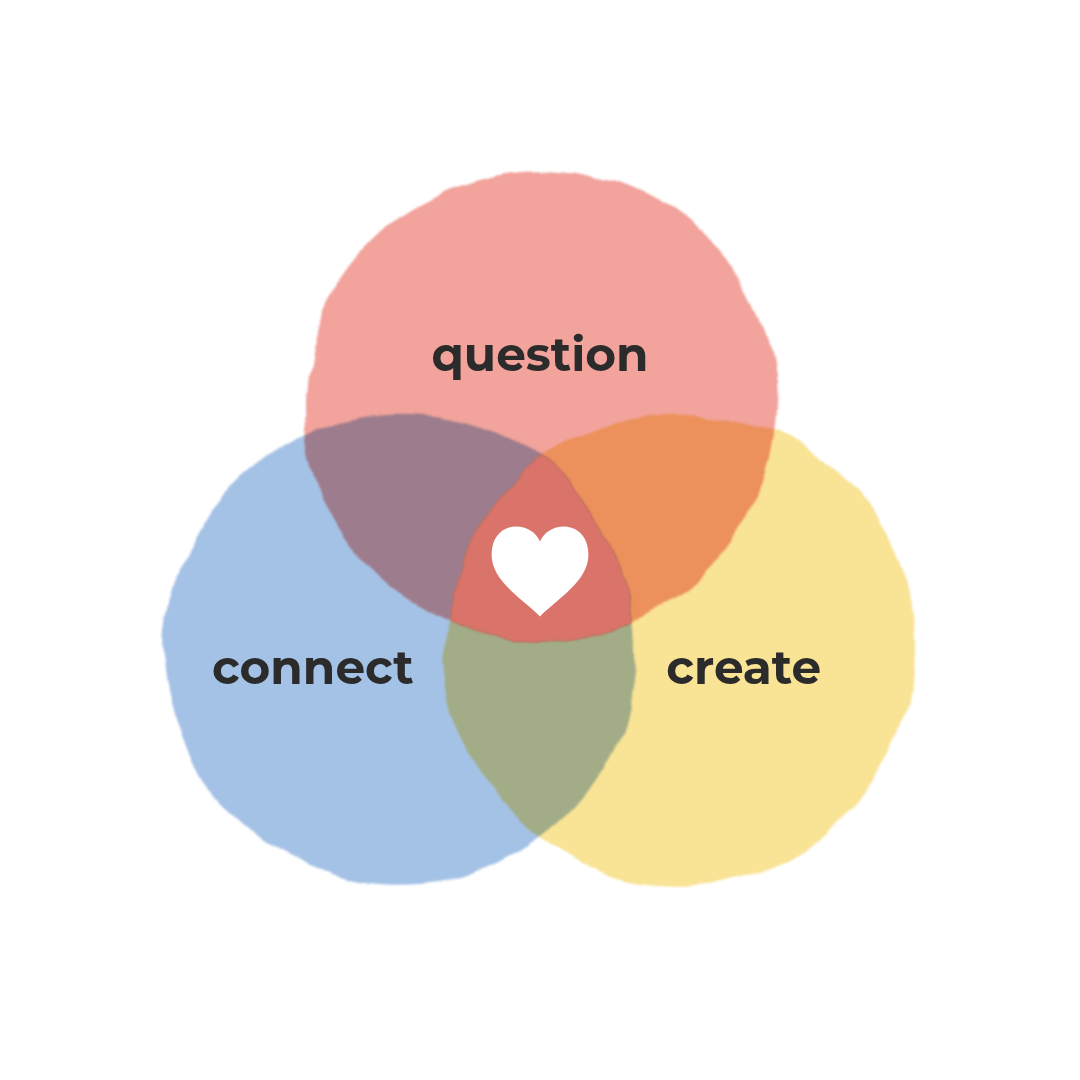
You may already know the three parts of self-compassion: mindfulness, common humanity and self-kindness. But knowing them isn’t the same as living them ~ especially when your inner critic is loud.
The Heart-First Way turns each part of self-compassion into something you can do, with three verbs: question, connect, create.
If you joined me for Love Yourself Now, you’ve already had a taste of it. In Everyday Self-Compassion, we practice it together for 8 weeks, right in the middle of your real life.
You can take self-compassion out of your head and into your everyday life ~ just like these students did:

“They would recommend books and workbooks, but it was so frustrating.”
“For over five years, therapists had been telling me that I needed to work on self-compassion. They would recommend books and workbooks, but it was so frustrating.
They would tell me: ‘You need to be more self-compassionate; you’re being mean to yourself.’ And in my head, I was thinking: ‘I know I’m being mean to myself, but how can I actually change that?’ It felt hard to make real progress just by reading.
This class really helped me put into practice the things I needed to learn at a much deeper level than I’d ever reached before from books.
A lot of people talk about meditation, and while that’s helpful, it’s something I struggle with because of focus and getting stuck in my head. The art journaling is really what helped me because you have to physically do something with your body while you listen. That physical action helps the lessons sink in, stick, and translate into daily life.
I can honestly say that it’s made a huge difference. I'm a lot nicer to myself now, and I can show up better for those around me.”
Kelsey G.
“The Experimentation and Playfulness of Painting Opened Me Up”
“It opened up my creativity which had been closed off for years but the experimentation and playfulness of painting opened me up to everything else. As a person with a chronic illness, building self-compassion is hugely important. How I feel will change dramatically and instantly many times in a day - my instinct has been to ask ‘what did I do wrong?’ which is not helpful! These activities have given me tools for the situations in my life that happen on a daily basis. Also, I frequently experience either brain fog or distractibility. Painting has been the only time when my brain feels focused and present.”
Elizabeth H.
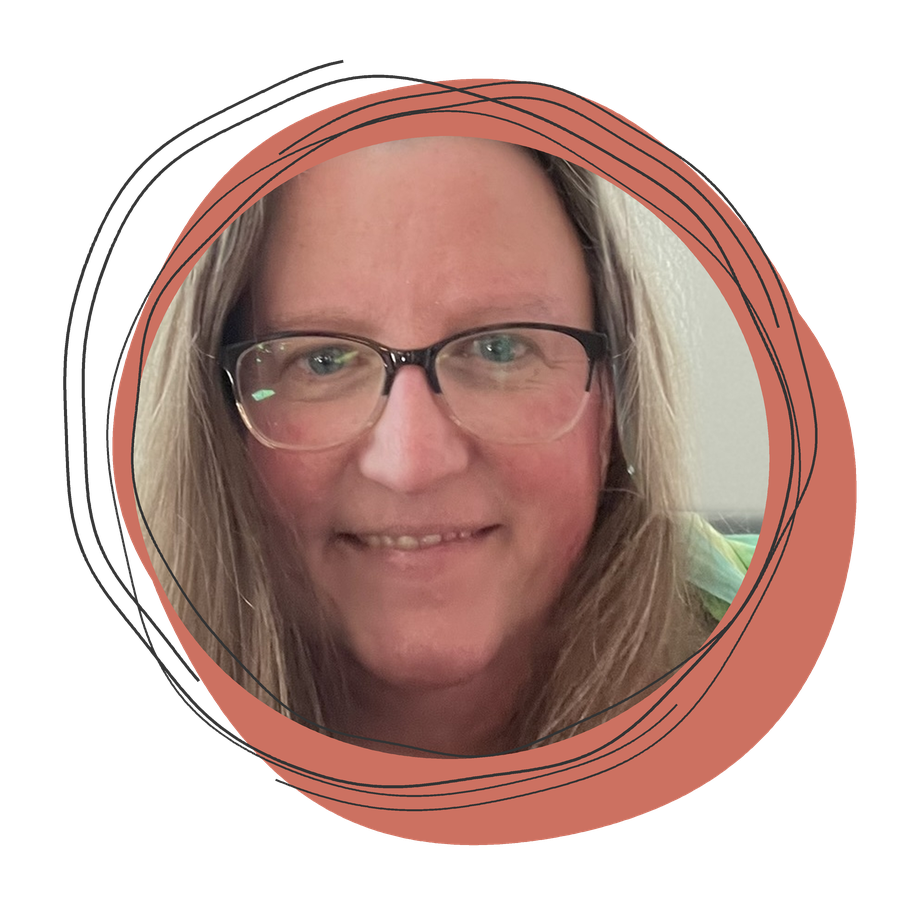

“This changed my life.”
“I knew I needed to learn how to be kind to myself. I had read about self-compassion and tried to do meditations, but something wasn’t sinking in. Art journaling got me to slow down and absorb what self-compassion means ~ especially common humanity. The practices we did in class helped me. Thank you for everything. This changed my life. I highly recommend this course to anyone!”
Patricia C.
“Like going from reading about swimming to actually diving into the water.”
“I’ve been meditating for years, and I’ve been studying self-compassion for years. But taking Lea’s course and doing these simple heart-centered drawings of my inner experience made me actually experience self-compassion on a visceral level. It was like going from reading about swimming to actually diving into the water.”
JoAnne T.
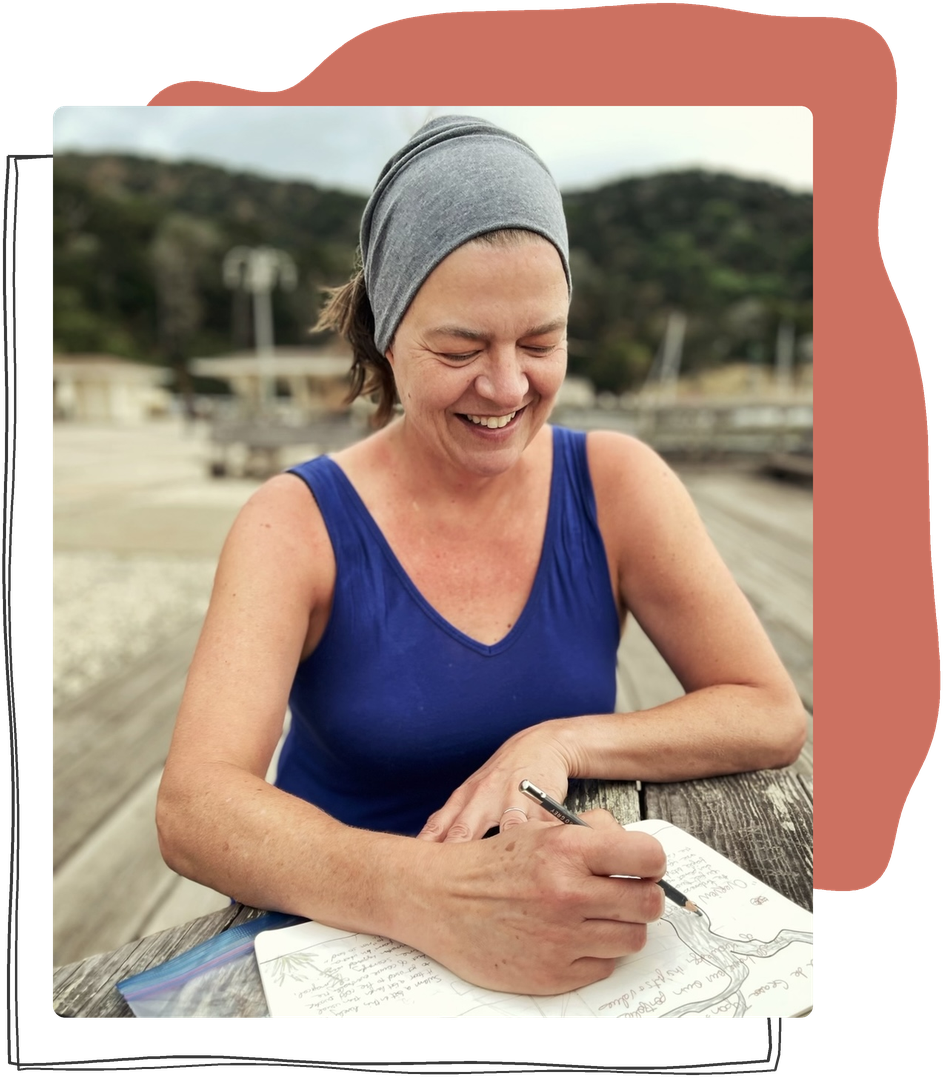
“I’ve learned it’s okay to make mistakes.”
“It’s changed my life ~ you can ask my friends. By putting my hand on my heart, I’ve learned to be more compassionate toward myself. I’ve learned it’s okay to make mistakes and that that’s part of learning. I’ve learned to take a step back and not be so judgmental of the things I do. I’ve learned to try new things, to experiment, to be curious and if I don’t like something ~ that’s okay. Sometimes I like it an hour later or the next day, or sometimes I just don’t like it. But that’s where I was at the moment, and that’s okay.”
Becca
See what’s waiting for you inside once you join…
Live classes, video learning &
simple, step-by-step art journaling practices every week!

GETTING STARTED
Get Clear on What You Want
and Begin to Activate Your Compassionate Self
Before our first class, you’ll ease in gently:
A guided art journaling practice to clarify your intentions, plus the basics of self-compassion.
“It’s been such a release to allow myself to make ‘bad art’ and not judge my efforts. My inner critic is so ruthless, but Lea is a match for it!”
Heather D.
Inside You’ll Discover…
♥︎A quick tour of your course home
so you know where to find your classes, videos and worksheets, and can relax into the experience
♥︎A guided practice to help you uncover your intentions
so you begin knowing what you truly want from these 8 weeks, not what you think you “should” want
♥︎The basics of self-compassion
what it really is (and what it isn’t), so we all start from the same foundation
And more…
WEEK 1
Discovering Self-Compassion
From Thinking About it to Living It
We’ll start by creating safety. You’ll get to know the others in the group, settle in, and explore the foundations of self-compassion ~ and then experience it for yourself…
…as an art journaling practice moves it out of your head, onto the page, and into your life.
“Speaking as someone who failed art in Grade 1 ~ these drawings stand out as pure solace as I learned what self-compassion is and how to bring it into my own life.”
Trudy B.
Inside Your First Class…
♡︎A gentle landing into the group
we get to know each other first, because feeling safe and seen is what makes it possible to open up
♡︎The foundations of self-compassion
what it truly is, why it matters, and how it differs from the self-criticism most of us were raised on
♡︎A guided art journaling experience
where you bring everything you’ve just explored onto the page
And more…
WEEK 2
Uncertainty, Every Day
An Unexpected Doorway to Self-Compassion
If uncertainty tends to knock you off balance, you’re not alone ~ most of us were never taught how to meet the unknown.
This week, you’ll see how normalizing uncertainty opens a path to self-compassion, and how to meet uncertain times with more steadiness and confidence.
Inside You’ll Discover…
♥︎Why uncertainty is so hard and why struggling with it doesn’t mean something is wrong with you
♥︎How turning toward the unknown (instead of bracing against it) opens the door to self-kindness
♥︎A simple 5-step process for the moments when self-kindness feels uncomfortable (a real and surprisingly common experience)
And more…
“I had a distressing experience and I let it bother me for a day or two. But I didn’t dwell on it, and I am thankful I didn’t choose any unhealthy coping mechanisms to squash the pain. I just chalked it up to it simply being one of those weird bumps in life - and life goes on. I faced it with equanimity.”
Elizabeth F.
WEEK 3
Feelings & Needs
What They’ve Been Trying to Tell You All Along
Inside You’ll Discover…
♡︎A way to understand how you feel
♡︎Five truths about feelings that most of us were never taught
♡︎How your feelings carry the information you need to be kind to yourself
♡︎An art journaling practice where you’ll decode what one of your feelings is telling you
And more…
Most of us learned to ignore our feelings and needs ~ to push through, stay busy, or insist we’re “fine.”
But your feelings are messengers, carrying the information you need to care for yourself.
This week, you’ll discover how to understand what you feel ~ and let it gently show you what you need.
“I have struggled with strong feelings for many years and did not know how to deal with them. Lea’s approach to slowing down to explore where these emotions reside was eye opening. She teaches you a new language by speaking softer, kind, curious words to gain awareness and move towards a more self-compassionate place. Through creative self-compassion and art journaling, my body, mind, and heart are embracing a more peaceful life.”
Susanne N.
WEEK 4
Boundaries & Connection
The Surprising Way to Honor Both in Your Relationships
“I have shifted from a person who has been highly critical of myself, most of my life ~ to the point of berating myself, to a person who holds space for my feelings, my needs, my boundaries, and the uncertainty of life. Thank you, Lea!”
Shannon F.
In week 3, you learned to hear what your feelings are telling you. This week, you’ll follow them to the next link in the chain, because when you know how you feel, you can name what you need. And “What do I need?” is essential to self-compassion.
That’s where boundaries come in, as a way of honoring two universal needs ~ connection and authenticity ~ in yourself and in others.
Inside You’ll Discover…
♥︎Why knowing how you feel is the first step to knowing what you need, and why “What do I need?” is the core question of self-compassion
♥︎A new way of seeing boundaries
not as pushing people away, but as a way to honor needs for connection and authenticity, in yourself and others
♥︎What your anger is really telling you about boundaries
♥︎A hands-on art journaling practice where you’ll explore what your anger reveals about a boundary in your own life, and identify practical steps to change it
And more…
HALF-DAY RETREAT
Room to Breathe and Be
with Creativity & Deep Care
When was the last time you had a few uninterrupted hours that belonged entirely to you?
The retreat is exactly that: a pause halfway through the program where everything you’ve learned so far gets to settle in ~ through familiar meditations, brand-new self-compassion practices, and the rare, restorative experience of silence.
Inside You’ll Discover…
♥︎Familiar meditations + new self-compassion practices
deepening what you’ve already learned while discovering fresh ways to care for yourself
♥︎Mindfulness, creativity & movement
three different ways into everyday presence, so you can find what works for you that day
♥︎The gift of silence
uninterrupted space to turn inward, focus on yourself, and listen for what you truly need
And more…
“I was transported to another place ~ a healing arena where I felt safe and relaxed. The poems were very impactful. Your voice was grounding and comforting. Afterwards I felt like I had gone to a day spa for my spirit. I was light the whole day and full of release.”
Carla V.
WEEK 5
Identity & Self-Esteem
Why You Don’t Need “High” Self-Esteem
If your sense of worth rises with every win and craters with every setback or disapproving glance, you know how exhausting conditional self-esteem is.
This week, you’ll step off that rollercoaster ~ and discover where a steadier kind of self-worth comes from: one that isn't dependent on achievements, praise, or being “enough” by someone else’s measure.
Inside You’ll Discover…
♡︎The self-esteem myth
why chasing high self-esteem isn’t the answer, and what matters for your well-being
♡︎Conditional vs. unconditional self-esteem
how to tell which one you’re running on, and why one leaves you fragile while the other holds steady
♡︎Unconditional sources of self-worth
where worth that doesn’t rise and fall with success or approval actually comes from
♡︎A hands-on art journaling practice
where you’ll identify your own sources of stable self-esteem and map out concrete, everyday ways to tap into them
And more…

“The component that I found really valuable was exploring my core values, and that’s to balance out the external validation that I’ve been dealing with the majority of my life ~ it’s strong! I guess I’ve always known what my core values are, but now I have a practice to understand them beyond words, and to live them.”
Elise P.
WEEK 6
Parts & Wholeness
You Contain Multitudes (And Each Part of You Belongs)
If you’re exhausted from trying to fix or hide certain parts of yourself, there’s a reason: an inner tug-of-war takes a lot of energy. This week, you’ll set down the struggle.
You’ll see how messiness is part of the very texture of being alive.
And once you stop fighting your parts, you can turn toward them and hear what they’ve been trying to tell you ~ because your shadowy aspects are often not what you think.
“Each day, I flip through the creations I made and smile. I’m amazed at how such simple drawings can have such a powerful effect. Through them, I feel a greater tenderness toward myself and others, my strong parts and my struggling parts alike. I can hold all my parts with love, grace, kindness, and playfulness too.”
Jodi B.
Inside You’ll Discover…
♥︎An image from nature’s psychedelic junk drawer
one glimpse and you may never call yourself “too messy” again
♥︎Your inner family, from infants to wise elders
a tender exploration of the system of parts you already are
♥︎Why we disown our parts
how perfectionism and cultural norms teach us that certain parts don’t belong, and what that inner tug-of-war drains: energy, ease, and fun
♥︎A practice of radical welcome on the page
invite in a part you’ve been struggling with and finally hear its side of the story
And more…
WEEK 7
Self-Judgment & Self-Kindness
The Inner Critic Is a Storyteller, Not a Truth Teller
When something goes wrong, whose voice do you hear inside? For most of us, it’s the critic ~ quick with a story of how we should have known better.
But self-judgment is a story ~ an interpretation of your experience that you can change.
You’ll see your critic with fresh eyes, interrupt the shame-blame cascade before it sweeps you up, and learn the steps to accessing the voice of self-kindness.
Inside You’ll Discover…
♡︎The “fiction of failure” that drives self-judgment
how your critic turns an uncomfortable feeling into a story about who you are
♡︎How to interrupt the shame/blame cascade
catch the reflex of blaming yourself (and others) when things don’t go as planned, and choose accountability over blame instead
♡︎The few simple words that quiet your critic
where it came from, what it’s really after, and how acknowledging its intentions and impact makes room for self-kindness
♡︎Kindness as your new motivator
practice with a real, everyday struggle and learn how to get things done without berating yourself first
And more…

“Self-compassion phrases are always in the front of my mind now. Instead of the inner critic at work, the inner compassionate self can take over with soothing phrases like: ‘I am willing to be imperfect... everyone makes mistakes... I am not alone.’ Going through my art journal is of great value in recalling the activities and accomplishments from the 8 weeks.”
Blaze A.
WEEK 8
Your Compassionate Self
Living What You Know
Remember the person who set her intentions in week 1, hopeful and not entirely sure what would happen? This week, you’ll look back at how far you’ve come ~ and forward at who you’re becoming. You’ll explore your compassionate self, gather the practices that were most helpful, and consolidate what you've learned.
You now know what it’s like to actually be kind to yourself in real life ~ and the tools you learned in the past 8 weeks are yours to keep.
Inside You’ll Discover…
♥︎The qualities of your compassionate self
what self-kindness looks and feels like in everyday life
♥︎Your personal practice toolkit
a look back over all 8 weeks to identify the practices that spoke to you, so you leave with a clear sense of what works for you in everyday life
♥︎How to keep it alive
simple ways to keep bringing these practices into your days, so the growth continues long after our last class together
And more…
“This class was honestly amazing. I have been in therapy for years but none of that came close to cracking my CPTSD like the 8 sessions of Everyday Self-Compassion did. This class has had a profound effect on my heart and my life... In this class I learned how to listen to my compassionate self, the voice of the positive parent I always deserved.”
Sarah
When & where
Here’s how our 8 weeks together will flow
8 live 2-hour classes on Zoom plus a half-day retreat
Dates for the next round go to the priority list first.
Half-day retreat
Included in the 8 weeks
Where
We’ll meet live on Zoom
Supplies
♡︎A watercolor set
♡︎A waterproof black pen
♡︎A mixed media or watercolor spiral-bound pad

Everyday Self-Compassion was built to give you skills you’ll use for the rest of your life.
Think about what it would mean to…
♡︎Try new things without needing to be good at them first
♡︎Soften that harsh inner voice that years of therapy never quite reached
♡︎Say no without guilt ~ and yes without resentment ~ because you trust what you need
♡︎Carry more confidence and less self-doubt into your work
♡︎Actually enjoy the life you have ~ and get clearer about what you want, so you can choose and create more of it
What you haven’t had yet is a way to embody all those breakthroughs and everything you know about self-compassion ~ something that works in your everyday life.
Join the Priority List

“There was a point in my life when I became more aware of my own self-talk, which at times wasn’t very kind. I could be very empathic toward others, and I realized that I wanted and needed to be my own best friend.
As the saying goes, ‘When the student is ready, the teacher appears.’ The art journaling practices Lea taught became the road to my compassionate self. The tools, resources, and research she shared opened doorways to the Self that feel deeply transformative.
If you’re ready to practice self-compassion, you’re in the right place.”
Gamida C.
You CAN Do This
You already know what self-compassion is.
It’s time to be kind to yourself in real life.
Join the priority list below, and you’ll be the first to know when the next round of Everyday Self-Compassion opens.
P.S. You’ve spent enough years just thinking about being kind to yourself. If your heart did a little flip reading this, pay attention to that.
Join the Priority List
Still Wondering if Everyday Self-Compassion Is Right for You? Read This!
FAQs
What if I’m not an artist and I can’t draw?
Do I need to know how to meditate?
I’ve tried everything and it’s still so hard to be kind to myself ~ why would this be different?
Is this a kind of group therapy? Groups can be scary. 😬
What if I am an experienced artist?
How much time will I need each week for this program?
Isn’t a class like this self-indulgent?
Shouldn’t I be able to do this myself?
Is this program right for me?
What’s a typical live class like?
Will live classes be recorded?
Is there homework?
I’m so tired of being on Zoom ~ is there any way to make it easier?
Do I need special supplies?
Do you offer scholarships?
How is Everyday Self-Compassion different from Mindful Self-Compassion?
Still have questions? Email [email protected]
Disclaimer: enrollment in Everyday Self-Compassion is not group therapy, and it is not a substitute for mental health services. Enrollment in Everyday Self-Compassion does not constitute a therapist-client relationship.